There’s a particular kind of Google Ads report that makes a marketer uncomfortable. You spend money bringing people to your website. They click the ad, visit a product page, look around, some add products to their cart, some even reach checkout. And then — nothing. No purchase.
The instinct is to ask: was the ad wrong? Was the product too expensive? Was the landing page poor? While managing Google Ads for an ecommerce business, I started looking at this differently. Not every non-conversion is rejection, but not every visitor is a future customer either. Sometimes it’s hesitation. That distinction changed how I think about remarketing entirely.
The Customer Who Didn’t Say No
Someone clicks an ad, explores a product, checks the price, thinks about it, and leaves. From the dashboard, that’s a non-conversion. From the customer’s side, the real thought might just be “I need to think about it.” That’s not rejection — it’s an unanswered question. Do I trust this brand? Is this right for me? Is the price justified? Should I ask someone first?
Remarketing isn’t just showing the same product to someone repeatedly. It’s a chance to continue a conversation the customer already started.
Our Campaign Made Me Ask a Different Question
When we started remarketing for our business, the obvious assumption was that people who’d already visited should be easier to convert — they know the brand, they’ve seen the products. But at one point, the campaign was spending money with zero conversion value. Instead of immediately increasing the budget or shutting the campaign down, I looked at the audience, landing pages, product categories, and customer journey. The goal wasn’t simply to get more impressions. I wanted to understand which stage of the journey was producing hesitation. Google now refers to remarketing audiences as “your data segments” in Google Ads. In this article, I’ll continue using “remarketing” because that’s the term most marketers still use when describing campaigns targeting previous website visitors.
A Remarketing Audience Isn’t One Audience
The biggest lesson was that “website visitors” isn’t a single group — it’s several groups at different levels of intent:
Discovery — just found the brand, asking “who are these people?”
Exploration — browsing categories, asking “do they have what I need?”
Consideration — spending time on a product, asking “is this right for me?”
Purchase intent — added to cart, asking “should I actually buy this?”
Checkout — very close, asking “is anything stopping me from finishing?”
These customers shouldn’t get the same message. Someone who visited once is still evaluating trust and fit. Someone who added a ₹2,000 product to their cart is weighing whether the price is worth it right now. Giving both the same ad is convenient for the advertiser, not useful for the customer. That’s when I stopped thinking of remarketing as “show the product again” and started thinking of it as “address the reason they hesitated.”
The Different Shapes of Hesitation
“I’m not sure about the product” — usually an information problem. The customer needs better product details, reviews, or reassurance about authenticity, not necessarily a discount. Sometimes they just need confidence.
“I’ll decide later” — a timing problem. They genuinely want it but don’t feel urgency, and then life happens. This is especially relevant for festival, pooja, or seasonal purchases. Remarketing here works best by giving a timely, relevant reason to return — an upcoming festival, a seasonal bundle — not by shouting “buy now.”
“It’s too expensive” — marketers often jump straight to a discount, but price resistance often means “I don’t understand why this costs this much,” which is a value problem, not a price problem. Communicating quality, ingredients, sourcing, or bundle value increases perceived value. A discount solves a price problem. It doesn’t always solve a value problem.
“I don’t trust the website yet” — especially relevant for brands still building familiarity. Will my order arrive? Is payment safe? What if something goes wrong? Reviews, clear contact information, delivery details, and visible trust signals matter here. The ad can bring the customer back, but the website has to finish the job — remarketing can’t compensate indefinitely for a site that doesn’t answer basic concerns. No amount of clever retargeting fixes a missing return policy or a checkout page that feels sketchy on a first glance.
“Maybe I need something else too” — not rejection, just uncertainty about what else is needed. This is where bundling helps: instead of “come back and buy the product you viewed,” it becomes “complete your daily pooja with these essentials.” That’s decision support, not just a reminder, and it can also create opportunities to increase average order value by helping customers discover complementary products.
Advertising Is Messier Than It Looks
I used to think advertising worked like:
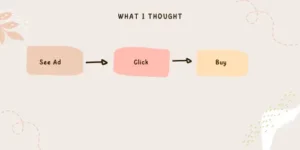
Real campaigns look more like:
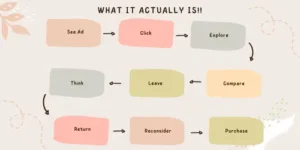
Sometimes that takes minutes, sometimes days, sometimes longer. Remarketing lives in that middle space — the bridge between “I’ve seen this” and “I’m ready to buy this.” I stopped thinking of remarketing as a separate advertising tactic and started seeing it as part of the customer’s decision-making process.
Remarketing Isn’t Magic, and It Isn’t Chasing
It’s tempting to assume a remarketing audience is automatically “warm” and easy to convert. It isn’t. That audience can contain people who landed accidentally, people comparing competitors, people genuinely about to buy who just got distracted — treating them all as identical warm leads is a mistake. Audience quality, timing, and message all matter, and so does the original reason for the hesitation.
There’s also a fine line between reminding someone and following them around. A customer who viewed a product once shouldn’t see it aggressively everywhere. Good remarketing feels like “here’s something that may help you finish deciding,” not “you looked at this — why haven’t you bought it?” One respects the customer. The other creates pressure. The goal isn’t to chase people until they convert. It’s to stay useful while they’re still deciding.
Don’t Forget the Privacy Side
Google treats remarketing as personalized advertising and has specific requirements around data collection, consent, and audience use. Your website should clearly explain relevant data practices through its privacy policy, and remarketing implementation must follow applicable Google Ads policies and local privacy requirements.
Answering Questions Instead of Repeating Ads
A weak remarketing campaign says “you saw this, come back.” A stronger one asks what might have stopped the purchase, then addresses that specific barrier — credibility if it’s trust, value explanation if it’s price, simplicity if it’s complexity, a relevant reason to return if it’s timing, a bundle if it’s product selection. That’s the shift from advertising repetition to actual decision support.
This also changed how I read analytics. A campaign can have good impressions, solid CTR, reasonable CPC, real traffic — and still underperform on sales. That doesn’t mean the ad failed. The break could be anywhere: ad to landing page, landing page to product, product to cart, cart to checkout, checkout to payment. The ad is only one link in that chain, which is why I’ve started treating marketing less like a set of separate tools and more like one connected system.
What I’d Do Differently From the Start
If I were building remarketing from scratch today, I wouldn’t begin with “retarget everyone who visited.” I’d start with the customer journey: help product viewers understand why it’s worth considering, help cart abandoners by removing friction, help checkout abandoners by addressing final doubts, give past customers a reason to return, and introduce high-value customers to complementary products. The message should change based on where the customer stopped — that matters far more than simply increasing remarketing frequency.
The Bigger Lesson
The real lesson here wasn’t about Google Ads. It was about people. Customers compare, postpone, ask someone else, get distracted, forget, come back, and leave again — and eventually something shifts. The need becomes urgent, or trust builds, or a bundle finally makes sense. A good marketer doesn’t assume the customer was wrong for not buying immediately. They try to understand what was missing from the decision.
I used to ask “how many conversions did we get?” Now I ask “where did the customer hesitate?” That’s a far more useful question, because a missed sale isn’t always a lost customer. Sometimes they need more information, more confidence, better timing, or a better offer. And sometimes they simply weren’t ready yet — which isn’t a no. It’s a “not yet.”
Conversion isn’t always a single moment. The ad creates awareness, the website creates understanding, the product page creates consideration, and remarketing brings the brand back into view at the right time to reduce whatever friction is left. That’s not “advertising to people who already visited.” It’s helping people who’ve already shown interest get past whatever’s still holding them back.
Final Thought
Running Google Ads for a real business has taught me that data tells us what happened, but not always why. A report can say “zero conversions.” It can’t say “the customer wasn’t convinced yet.” That gap is exactly where marketing judgment has to step in — the numbers point to where to look, customer behavior helps explain what to look for, and strategy decides what happens next.
The job of remarketing was never to chase the customer until they gave in. It’s to remove whatever hesitation kept them from moving forward in the first place. Not every visitor who leaves without buying has said no. Most of the time, they’re just saying “not yet” — and that’s a very different problem to solve.