A few months ago, if someone had asked me, “Do you know Google Ads?”, I would have confidently said, “Yes.”
Today, after spending weeks inside a live Google Ads account, I would answer differently.
“I’m still learning Google Ads. But now, I’m learning it the right way.”
The difference?
Earlier, I knew Google Ads as a platform. Today, I understand Google Ads as a business decision.
And that changed everything.
It Started With a Simple Question
Our journey didn’t begin with creating campaigns.
It began with questions.
- Why isn’t this Shopping campaign getting impressions?
- Should we trust Google’s recommendations?
- Why is our Brand campaign showing only a 12% Impression Share?
- Is Performance Max better than Search?
- Why are conversions increasing but revenue isn’t?
Every answer uncovered three more questions. That’s when I realized something important. Running Google Ads isn’t about pressing the “Publish Campaign” button.
It’s about understanding why every click happens.
Google Doesn’t Know Your Business
One of the biggest lessons came from Google’s own recommendations.
Almost every day Google suggested:
- Increase your budget.
- Raise bids.
- Enable automation.
- Create an Investment Strategy.
At first, those suggestions looked convincing. But then we started asking a different question.
“Will this actually improve the business?”
Sometimes the answer was yes.
Sometimes the answer was no.
For example, Google recommended increasing the budget on our Brand campaign.
On paper, it made sense. But after looking deeper, we found that our budget wasn’t the only factor. Search intent, keyword quality, impression share, and campaign objectives mattered just as much.
That was the moment I stopped treating recommendations as instructions and started treating them as inputs.
Every Metric Has a Story
One day we noticed something strange. Our Shopping campaign had a very low Conversion Value.
The easy conclusion would have been:
“The campaign isn’t working.”
But when we looked closer, we discovered something else.
The campaign had:
- Good CTR
- Very low spend
- High Search Lost Impression Share (Rank)
The problem wasn’t that customers didn’t want the product.
The problem was that Google wasn’t showing it often enough.
A small bidding setting—a ₹1 maximum CPC limit—was quietly preventing the campaign from competing.
One tiny setting changed the entire interpretation of the campaign.That’s when I realized:
Metrics don’t tell the whole story. Context does.
Search Before Automation
Performance Max is impressive.
Our account showed good results with it. But we still decided to build Category Search Campaigns.
Why?
Because Search campaigns teach you something that automation can’t.
They tell you:
- What people are searching for.
- Which words they use.
- Which categories deserve investment.
- Which products customers are actually looking for.
Instead of guessing what people wanted, we let search behavior guide us.
That’s why our next campaign wasn’t built around a single product.
It was built around a category:
Pooja Products.
Not because it was fashionable.
Because that’s how customers think.
We Stopped Selling Products
Something else changed during this journey.
Instead of asking:
“How do we sell Deepam Oil?”
We started asking:
“What problem is the customer trying to solve?”
That shifted our thinking completely.
For festivals, people weren’t buying agarbatti.
They were preparing for devotion.
For Gruhapravesham, they weren’t buying a brass diya.
They were gifting blessings.
That insight influenced not only our campaigns but also how we thought about product bundles, landing pages, and even packaging.
Marketing became less about products and more about purpose.
The Best Decision Wasn’t a Campaign
One of the most valuable decisions we made wasn’t launching a new ad. It was deciding not to launch one.
Instead of creating five campaigns at once, we slowed down.
We chose one category.
One campaign.
One objective.
Collect data.
Learn.
Improve.
Then scale.
That patience is difficult when you’re eager to grow, but it’s often what separates sustainable advertising from expensive experimentation.
What This Journey Reinforced
Managing Google Ads for a real business reminded me that marketing isn’t about chasing dashboards.
It’s about asking better questions.
- Is this campaign profitable?
- Is the landing page helping conversions?
- Are we attracting the right customer?
- Are we building a brand, or only buying clicks?
The platform provides data.
Experience helps interpret it.
Business understanding helps decide what to do next.
My Biggest Takeaway
If there’s one lesson I’ll carry into every future project, it’s this:
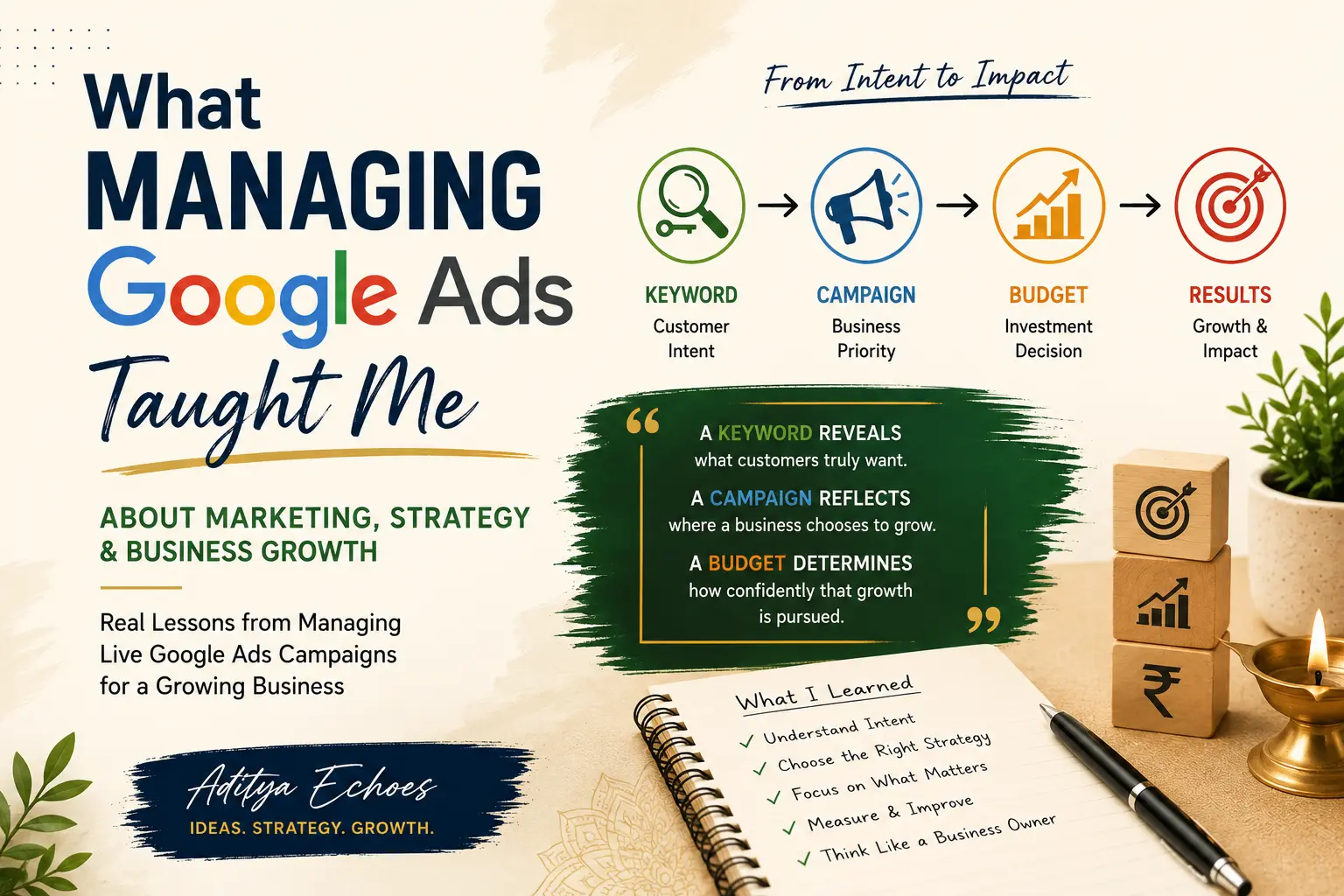
Google Ads is not a marketing tool. It’s a business decision-making tool.
Every keyword represents customer intent.
Behind Every campaign reflects a business priority.
Every budget increase is an investment decision.
When you start looking at Google Ads through that lens, the conversations change.
You stop asking:
“How do I get more clicks?”
And you start asking:
“How do I build a business that deserves those clicks?”
That, in my experience, is where real digital marketing begins.
This article is based on my ongoing experience managing live Google Ads campaigns for an FMCG brand. The lessons aren’t from textbooks—they’re from real campaigns, real data, real discussions, and many iterations. And the learning continues every day.