Why Customers Buy Without Realizing It
Picture this. You walk into a supermarket for one thing: milk. Fifteen minutes later, you’re at the checkout with milk, a bag of chips, a chocolate bar, and a soft drink you didn’t even know you wanted. Nobody forced you. Nobody tricked you. And yet, somehow, your cart tells a different story than your shopping list.
Or think about the last time you searched online for something oddly specific — say, “best pooja oil.” You clicked one link, skimmed the page for maybe ninety seconds, and placed an order with a brand you’d never heard of before that moment.
We like to believe we’re rational shoppers. We tell ourselves we compare prices, read the specs, weigh the pros and cons. But the truth is a little stranger, and a lot more human: by the time you consciously “decide” to buy something, your brain already made up its mind.
Meet the Two Minds Running the Show
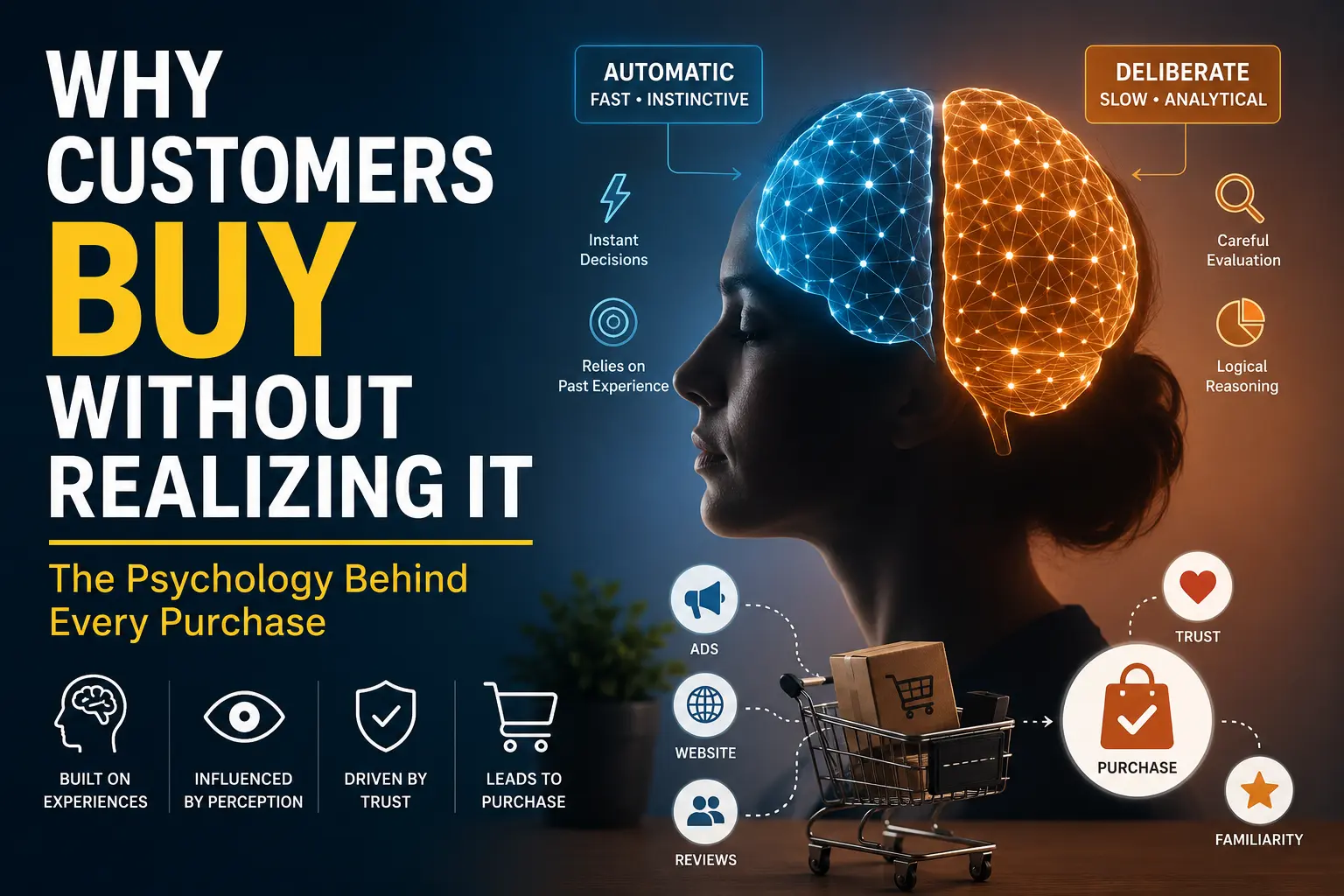
Here’s the part that surprises most people. You don’t have one thinking system — you have two, working side by side.
The first is fast. Instinctive. It’s the system that yanks your foot to the brake pedal the instant a pedestrian steps off the curb, before you’ve even registered what you saw. It doesn’t reason things out; it recognizes patterns and reacts.
The second is slow. Deliberate. It switches on when something is new, complicated, or important — comparing two insurance plans, reading through reviews before a big purchase, doing the mental math on whether something is worth the price tag.
The interesting part is that these two systems aren’t rivals. They’re partners. Every time your slow, careful mind works through a decision, it leaves a trace behind. Do that enough times in similar situations, and the fast system picks up the pattern and takes over. What once felt like a decision starts to feel like an instinct.
That’s not a flaw in human psychology. It’s efficiency. And it’s exactly what smart brands learn to work with, instead of against.
Why “I’ve Seen This Before” Feels Like “I Can Trust This”
This is where familiarity enters the story, and it might be the single most underrated force in marketing.
Say a friend mentions a skincare brand over coffee. A week later, you see the same name pop up in your Instagram feed. A few days after that, it shows up in a Google search when you’re looking for something else entirely. You’ve never bought a single product from them — but the next time you see their name, something in your gut says, I know this one.
That feeling isn’t logic. It’s recognition. Your automatic mind has quietly logged several encounters and stitched them into a sense of “this is familiar, therefore this is probably fine.” You don’t consciously replay each interaction — you just feel more at ease.
This is exactly why a brand that shows up consistently, over months, tends to outperform a competitor throwing everything into one flashy campaign. One big push creates a spike of attention. Repeated, steady presence builds trust.
The Sale Starts Long Before the “Buy Now” Button
A lot of business owners assume the persuasion happens on the product page — that the real work begins the moment someone starts reading the description. In reality, the sale is often decided long before that.
Think about everything a customer runs into before they ever reach your product:
- The headline in a Google search result
- How fast the page loads
- The quality of the product photos
- The tone of a blog post they read last week
- A friend’s offhand recommendation
- The colors and layout of your homepage
Every one of these moments is quietly shaping an opinion, whether you planned it or not. It’s a bit like preparing soil before you plant anything. Good soil doesn’t guarantee a harvest, but bad soil almost guarantees you won’t get one. By the time a customer reaches your “Buy Now” button, the outcome is often already decided by everything that came before it.
Your Brain Is Lazy — In a Good Way
Here’s something worth sitting with: you make thousands of small decisions every single day. If you consciously analyzed all of them, you’d be mentally exhausted before lunch.
So your brain cheats — smartly. Instead of asking “is this objectively the best option available?”, it asks quicker, blunter questions:
- Does this look legit?
- Have I run into this name before?
- Does the site feel put-together or thrown together?
- Are other people saying good things about it?
Notice what’s missing from that list — the product itself barely gets a mention. Most of what’s being judged is everything around the product.
This is exactly why two companies can sell nearly identical products and land in completely different places. The gap usually isn’t quality. It’s perception.
A Tale of Two Websites
Let’s make this concrete. Imagine you’re shopping for herbal incense sticks, and you open two tabs.
The first website has sharp product photography, honest customer reviews, a clear returns policy, and loads almost instantly. The second has grainy images, half-finished product descriptions, and a spinning loading icon that tests your patience.
Even if the incense sticks inside those boxes are chemically identical, you already know which one you’re more likely to buy. And if someone asked you why, you’d probably say something like, “It just seemed like the better product.”
But that’s not quite what happened. What actually happened is your brain made an emotional judgment first — this feels trustworthy — and your logical mind stepped in afterward to write the explanation. This isn’t a one-off. It’s the quiet undercurrent beneath almost every purchase we make.
The Search Results Page Is Already Part of the Sales Pitch
Most marketers pour their energy into the landing page and treat the search results page as a formality. But the customer’s first impression usually forms before the click.
Compare these two listings for the same product:
Listing A: Deepam Oil
Listing B: Pure Deepam Oil for Daily Pooja | Fast Delivery
Listing B does more work in one line than Listing A does in its entirety. It signals relevance, specificity, and reliability before the customer has even landed on the page. That’s why good SEO isn’t just a ranking game — it’s an expectation-setting game.
A Website Talks, Even When It Says Nothing
Customers read websites the way people read body language — mostly without realizing it.
A clean, modern layout quietly says “we’re professional.” A fast-loading page says “we’re reliable.” A detailed product description says “we know what we’re talking about.” A visible, easy-to-understand return policy says “we’re not afraid of accountability.” Genuine, specific reviews say “real people stand behind this.”
None of these are things a customer consciously tallies up. But each one chips away at uncertainty, and less uncertainty almost always means more trust.
This is where a lot of businesses stumble. They’ll spend generously on ads to get the click, then hand the visitor off to a website that undercuts everything the ad just promised. Getting someone to click is only half the job. What happens after the click has to hold up its end of the deal.
Why Showing Up Consistently Beats Showing Up Loudly
Every touchpoint a customer has with your brand is a small lesson their brain quietly absorbs. A genuinely useful blog post. A YouTube video that actually answers the question in the title. A LinkedIn post worth pausing to read. A product page that looks like someone cared about it. A review from a real customer with a real story.
None of these moments close a sale by themselves. But stack enough of them together, and something shifts. The automatic, fast-thinking part of the brain starts recognizing your brand faster and more comfortably each time.
That’s the real payoff of consistency. It’s not just about staying visible. It’s about training the customer’s mind to relax around your brand — and a relaxed mind is a mind that’s ready to buy.
Turning This Into Practice
Once you understand how customers actually think, the whole approach to marketing starts to shift. Instead of leaning on louder sales pitches, the smarter move is building experiences that quietly earn confidence over time. In practice, that looks like:
- Publishing content that solves a real problem, not just content that promotes a product
- Keeping your branding consistent across your website, ads, and social channels
- Investing in page speed and genuinely good product photography
- Answering the questions customers haven’t even asked yet
- Featuring reviews and testimonials that sound like real people, because they are
- Showing up regularly with helpful content instead of only during sales pushes
None of these single-handedly wins a customer. Together, they quietly shape how a customer feels about you long before they ever reach checkout.
Two Companies, Same Product, Very Different Outcomes
Imagine two companies both selling herbal incense sticks, both with identical monthly ad budgets.
Company A skips straight to running Google Ads. Company B spends the first few months doing the less glamorous work — fixing up the website, writing genuinely useful blog content, collecting real reviews, tightening up page speed — and then turns on ads.
More often than not, Company B comes out ahead. The ad brings the visitor to the door. But it’s everything Company B built beforehand that convinces the visitor to walk through it. The ad opens the conversation; trust is what actually closes it.
The Story Underneath Every Purchase
No purchase happens in a single moment, even when it feels that way. It’s the sum of dozens of small, half-noticed experiences — a search result, a loading screen, a review, a friend’s comment — that quietly built up long before the customer ever reached for their wallet.
Your analytical mind learns from new experiences. Your automatic mind stores those lessons and pulls them out instantly the next time a similar decision comes up. That’s why familiarity carries so much weight — it’s not a marketing trick, it’s how the brain is wired to work. The more genuine, positive moments someone has with your brand, the more naturally trust builds on its own.
Great marketing was never really about pushing people toward a decision. It’s about removing enough uncertainty that the decision starts to feel obvious.
Chase the quick sale, and you’ll get exactly that — quick, and rarely lasting. Build the relationship instead, and in a market this crowded, that relationship becomes the one advantage that’s genuinely hard to copy.