For a long time, I thought Quality Score was one of those Google Ads metrics you checked, nodded at, and moved on.
You see a keyword with a good Quality Score and think, “Great, Google likes this keyword.”
You see a low score and think, “We need to improve the ad.”
But after actually managing a live account, I realised that Quality Score is much more useful when you stop treating it as a score to improve and start treating it as a diagnostic tool.
One campaign in particular made this very clear.
I was managing a Search account for an e-commerce business selling a mix of traditional, wellness and everyday consumer products. The account had several campaigns running simultaneously — Search, Brand Search, Performance Max and Shopping.
The interesting part was that some campaigns looked excellent at the campaign level. But when we went deeper, the story became much more complicated. And that’s where Quality Score became useful.
The Campaign Looked Healthy From the Top
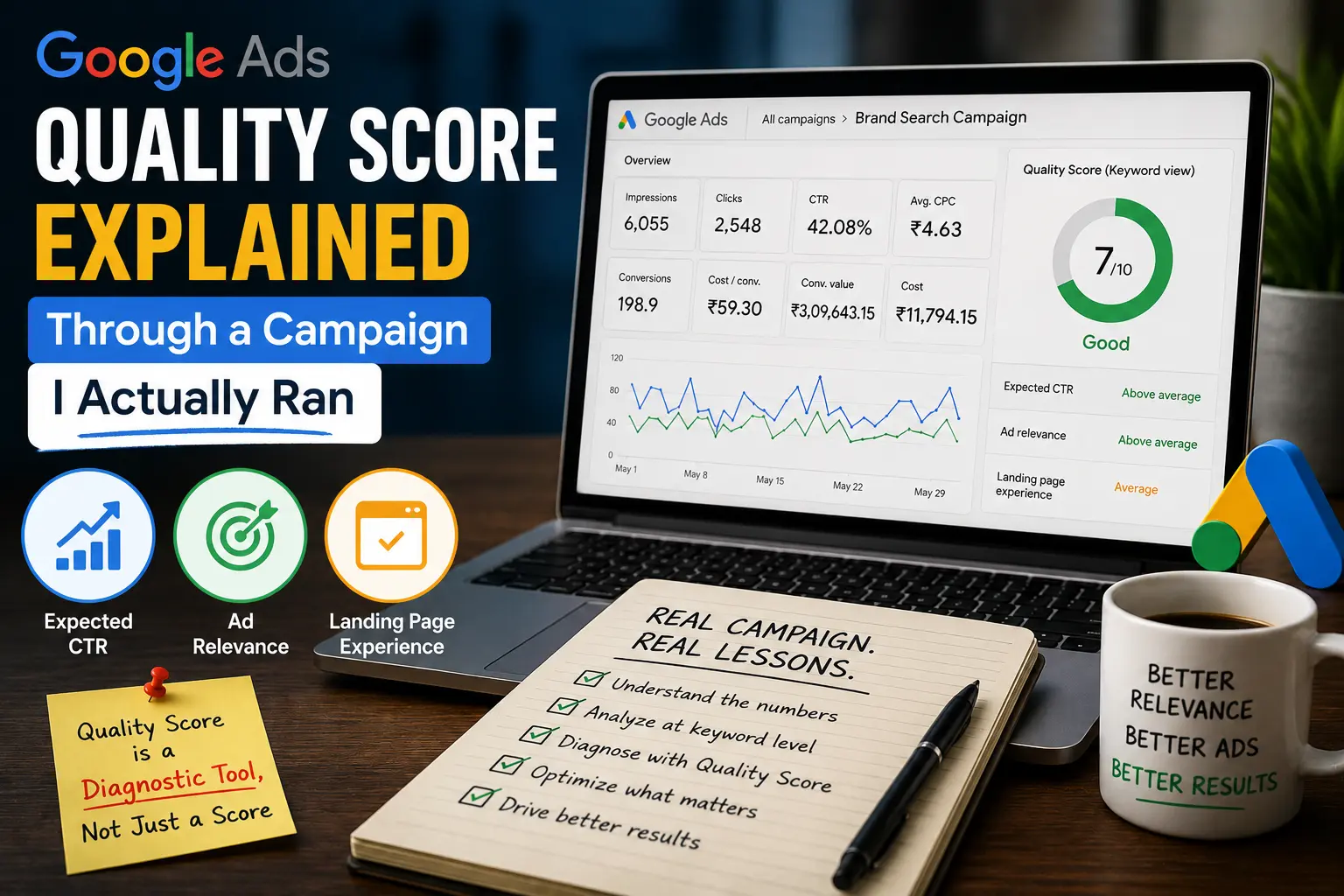
One of the campaigns I was monitoring was a Brand Search campaign. At first glance, there wasn’t much to complain about. For the period we analysed, the campaign had:
- 6,055 impressions
- 2,548 clicks
- 08% CTR
- ₹4.63 average CPC
- ₹11,794.15 spend
- 9 conversions
- 81% conversion rate
- ₹59.30 cost per conversion
- ₹3,09,643.15 conversion value
Those numbers immediately tell you something important:
The campaign was not fundamentally broken.
In fact, the click-through rate was extremely strong. The conversion value was substantial. The cost per conversion was reasonable relative to the revenue being generated. So if I had looked only at the campaign dashboard, I could easily have concluded:
“The campaign is performing well. Don’t touch it.”
But that’s exactly where many Google Ads managers stop.
I didn’t want to stop there.
Because campaign-level performance tells you what happened.
It doesn’t necessarily tell you why it happened.
First Lesson: Quality Score Is Not a Campaign Score
This is probably the most important thing to understand. Quality Score is primarily a keyword-level diagnostic metric. It isn’t the same thing as:
- Campaign optimization score
- Ad Strength
- CTR
- Conversion rate
- ROAS
These metrics can influence how you interpret the account, but they aren’t interchangeable. This distinction became particularly important in our account. For example, we had ads where the Ad Strength could be Poor, Average or Good. That does not mean the keyword automatically has a corresponding Quality Score. Likewise, a campaign can have an excellent CTR while individual keywords still have opportunities around Quality Score components.
So I stopped asking:
“What is the Quality Score of this campaign?”
and started asking:
“Which keywords are telling me that the relationship between the search, keyword and ad experience isn’t as strong as it could be?”
That is a much better question.
So What Actually Determines Quality Score?
Google breaks Quality Score into three major components:
- Expected CTR
Will people likely click this ad when they search for the keyword?
- Ad relevance
Does the ad actually relate closely to what the person searched for?
- Landing page experience
Does the landing page provide a useful and relevant experience after the click?
Each component can give you a different clue. And this is where Quality Score becomes more interesting. Imagine someone searches:
“brand herbal shampoo”
and your keyword, ad copy and landing page are all tightly aligned.
You have:
Search → Keyword → Ad → Landing Page
all telling the same story. That’s what you want.
But imagine the keyword is:
“herbal shampoo”
And the ad talks broadly about an entire product catalogue, while the landing page takes the user to the homepage.
You might still get clicks.
You might even get conversions.
But you’ve created unnecessary friction.
Quality Score can help expose that problem.
The Mistake I Initially Wanted to Avoid
When I started analysing the campaign, there was a temptation to improve everything. That’s dangerous.
A low Quality Score doesn’t automatically mean:
“Pause the keyword.”
And a high Quality Score doesn’t automatically mean:
“Increase the budget.”
This is where actual campaign management differs from simply following recommendations inside Google Ads.
I wanted to understand the commercial importance of the keyword first. For every keyword, I would think about four questions:
- Is it generating impressions?
- Is it generating qualified clicks?
- Is it generating conversions?
- Is the conversion value worth the cost?
Only after that would I use Quality Score to diagnose the keyword.
What If a Keyword Has a Low Quality Score but Converts?
This is where things get interesting.
Suppose a keyword has a Quality Score of 5/10.
It generates:
- Good traffic
- Regular conversions
- Acceptable CPA
- Strong revenue
Would I immediately pause it?
Absolutely not.
The Quality Score is telling me:
“There is room to improve the efficiency or relevance of this keyword.”
It is not necessarily telling me:
“This keyword is useless.”
That distinction matters. If the keyword is commercially valuable, I would investigate the three components. Maybe the expected CTR is below average.
Then I’d test better messaging. Maybe ad relevance is weak. Then I’d consider restructuring the ad group around tighter themes. Maybe landing page experience is the problem.
Then I’d look at whether the user is being sent to the right product/category page.
The Ad Group Structure Became More Important
This campaign also reinforced something I’ve learned repeatedly:
Keyword structure affects how easily you can create relevant advertising.
If one ad group contains:
- cow ghee
- herbal shampoo
- pooja oil
- incense
- pooja products
then writing one highly relevant ad becomes difficult. You can technically create a responsive search ad with many headlines.
But the underlying themes are still disconnected. Google has more combinations available, but the advertiser hasn’t necessarily created a clean relevance structure.
Compare that with an ad group focused specifically on:
Cow Ghee
Now your keywords, headlines and landing page can all reinforce the same intent.
For example:
Keyword:
pure cow ghee online
Headline:
Pure Cow Ghee Online
Headline:
Natural Cow Ghee
Description:
Shop pure cow ghee online. Explore quality products and order directly from our store.
Landing page:
Cow Ghee category/product page
That’s a much cleaner relationship.
CTR Taught Me Another Lesson
Our Brand Search campaign had a 42.08% CTR during the period we analysed.
That is a very strong signal.
But here’s the trap:
You cannot look at a high CTR and declare:
“Quality Score must be perfect.”
Why?
Because quality score has multiple components. And because CTR itself needs context. Brand searches naturally tend to have strong intent.Someone already looking for your brand is fundamentally different from someone searching a generic category term.
So comparing Brand Search CTR with generic Search CTR can be misleading.
This is one reason I don’t use a single benchmark such as:
“CTR above X% is good.”
The question is always:
Good compared with what type of search intent?
Quality Score Also Changed How I Looked at CPC
This is one of the most practical reasons to care about Quality Score. Google Ads isn’t simply:
“Highest bidder wins.”
Ad Rank considers several factors, including bid, ad quality and other signals.
So improving relevance can contribute to better auction economics.
But I wouldn’t make the mistake of saying:
“Increase Quality Score and CPC will automatically fall.”
Real auctions are much more complicated. Instead, I’d think about it this way:
Better relevance gives Google more reasons to consider your ad a useful answer to the search.
That can contribute to stronger ad performance and potentially better economics.
But actual CPC still depends on competition, auction dynamics, bid strategy and other factors.
The Most Important Discovery: Don’t Chase the Score
This became my biggest takeaway. Imagine I have two keywords.
Keyword A
Quality Score: 9/10
Spend: ₹500
Conversions: 0
Keyword B
Quality Score: 6/10
Spend: ₹5,000
Conversions: 40
Which one deserves my attention?
Obviously, Keyword B.
Why?
Because Keyword B is affecting the business.
The Quality Score tells me there may be room for improvement, but the conversion data tells me whether the keyword matters commercially.
This is why I now treat Quality Score as a diagnostic metric rather than a KPI. The KPI is business performance. Quality Score helps explain how efficiently the account is achieving it.
What I Would Actually Change
If I were auditing the campaign again, my workflow would be:
Step 1: Sort keywords by spend
Find where the money is actually going.
Step 2: Look at conversions and conversion value
Identify the keywords that matter commercially.
Step 3: Check Quality Score
Now investigate whether those important keywords have relevance or experience issues.
Step 4: Examine the three components
- Expected CTR
- Ad relevance
- Landing page experience
Step 5: Fix the specific problem
Don’t blindly rewrite everything.
Step 6: Review Search Terms
This is critical. The keyword you added isn’t necessarily the exact query that triggered the ad.
Search Terms tell you what people actually typed. And that’s where another part of our account management work became important: controlling wasted spend through search-term analysis and negative keywords.
Quality Score Doesn’t Solve Wasted Ad Spend
This is another misconception I had to unlearn. If you’re wasting money on irrelevant searches, improving Quality Score isn’t the solution.
Your first problem is traffic quality.
For example, if you sell premium products and Google is matching your broad keyword against searches that aren’t commercially relevant, your problem might be:
- Keyword targeting
- Match type
- Search terms
- Negative keywords
- Campaign structure
Not Quality Score.
This is why I now look at Google Ads in layers:
Search Terms → Keywords → Ads → Landing Pages → Conversions → Revenue
Quality Score sits inside that system. It doesn’t replace it.
What This Campaign Taught Me About Google Ads Management
The biggest lesson wasn’t actually about Quality Score. It was about how easily dashboards can make an account look simpler than it really is.
Our Brand Search campaign looked strong from the top.
42.08% CTR.
₹11,794 spend.
Nearly 199 conversions.
₹3.09 lakh conversion value.
Those numbers are useful.
But they don’t tell the entire story. The same account also had policy limitations, different ad strengths, budget constraints and campaigns with very different economics.
So the job wasn’t to chase one green number. The job was to understand where the account was strong, where it was leaking, and where an intervention could actually improve the business.
My Current Quality Score Checklist
Today, when I encounter a Quality Score issue, I ask:
Is the keyword commercially important?
If not, don’t waste hours optimising it.
Is the keyword getting meaningful impressions?
A low score on a keyword with almost no traffic isn’t necessarily an urgent problem.
Is the search intent clear?
If the keyword is too broad, structure may be the real issue.
Is the ad relevant?
Does the ad actually answer the search?
Is the landing page relevant?
Does the click lead somewhere useful?
What are the actual search terms?
This tells me whether the traffic matches the intended keyword.
Is the keyword converting?
Quality Score should never be analyzed in isolation from conversion performance.
The Real Meaning of Quality Score
If I had to explain Quality Score to someone managing Google Ads for the first time, I wouldn’t say:
“It’s Google’s rating of your keyword.”
I’d say:
“It’s a diagnostic signal that helps you understand how well your keyword, ad and landing-page experience align with what people are searching for.”
And that’s a much more useful way to think about it.
Because the goal isn’t to build a Google Ads account full of 10/10 keywords.
The goal is to build an account where:
the right person searches → the right ad appears → the right page opens → the person finds what they wanted → and the business makes money.
Quality Score is simply one of the tools that helps us understand how well that chain is working.
And after actually managing campaigns, that’s how I would use it:
Don’t chase the score. Diagnose the problem behind the score.
That is where Quality Score becomes genuinely valuable.