A few months ago, I found myself doing the same thing every morning.
I would open Meta Ads Manager.
Then Google Ads.
Then GA4.
Then WooCommerce.
Four tabs. Four dashboards. Four different versions of the same business.
Not because one of them was necessarily wrong. Each platform was measuring the business from a different layer, using its own tracking and attribution methodology.
But every morning, I was still doing the same thing: moving between them and trying to piece together a story that none of them was telling on its own.
I could see how my campaigns were performing.
I could see orders coming in.
What I couldn’t easily do was look at one actual order and understand the marketing information associated with that customer journey.
So I made a change that felt small at the time.
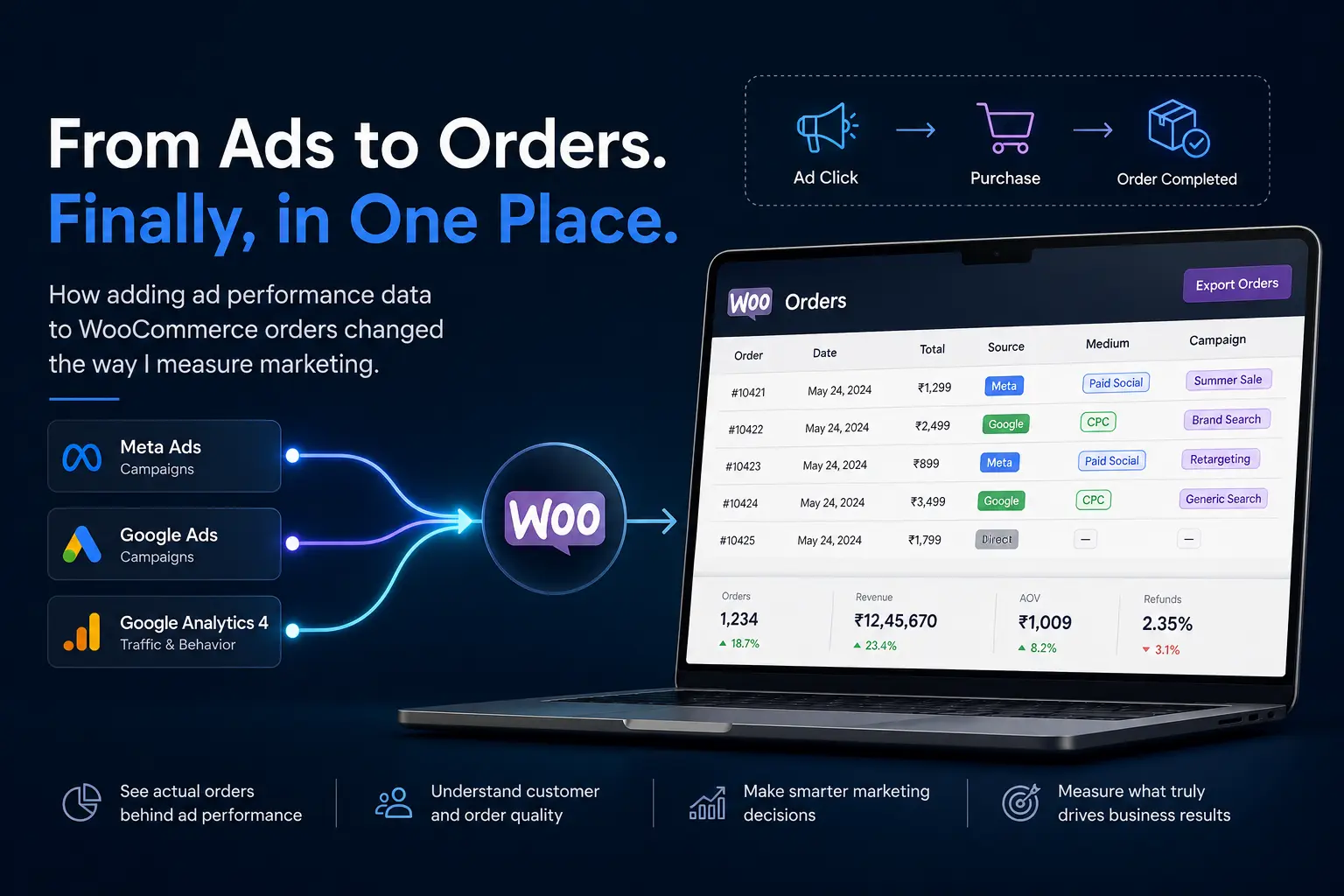
I started carrying advertising and campaign information into my WooCommerce order data and order exports — things like UTM source, UTM medium and UTM campaign alongside the order information.
It looked like a technical tweak.
A few extra fields in an export.
It ended up changing how I think about marketing.
The Problem With Watching Marketing From the Ad Platform’s Chair
Here’s a situation I kept running into.
Meta tells me:
Campaign A generated 50 conversions this week.
Google Ads tells me:
Campaign B generated 35.
On the surface, that’s a perfectly reasonable performance report.
But then I wanted to ask a slightly different question:
“Show me the actual orders behind those conversions.”
That’s where things got interesting.
An advertising platform is built to measure conversions and assign credit to the interactions that its attribution system considers relevant. Google, for example, currently supports data-driven and last-click attribution in Google Ads, while GA4 also has its own attribution reporting models.
So the platform isn’t necessarily giving me the “wrong” answer.
It’s answering a different question.
The business, however, eventually needs to know something much more concrete:
What transaction actually happened?
An order has a customer. It has products, revenue, payment status, shipping status and discounts. It can later be cancelled, returned or refunded.
That’s the business reality.
The advertising platform is one view of that reality.
The order system is another.
I wanted to bring those views closer together.
So I Moved the Data Closer to the Order
Instead of leaving marketing information inside advertising and analytics dashboards, I wanted some of the information I was capturing from the marketing journey to sit alongside the order it was associated with.
The basic logic was:
Order → Customer → Revenue → Source → Medium → Campaign
Now, when I opened an order export, I could start connecting the dots.
| Order | Revenue | Source | Medium | Campaign |
|---|---|---|---|---|
| #10421 | ₹1,299 | Meta | Paid Social | Summer Sale |
| #10422 | ₹2,499 | CPC | Brand Search | |
| #10423 | ₹899 | Meta | Paid Social | Retargeting |
| #10424 | ₹3,499 | CPC | Generic Search |
At first glance, this looks like a few additional columns in a spreadsheet.
It isn’t.
It changes the questions I can ask.
Before, I could ask:
“How did my campaign perform?”
Now I can also ask:
“What orders are associated with the marketing information we captured for this campaign?”
That second question is much closer to the business.
And there’s an important distinction here.
The UTM information I stored in WooCommerce isn’t a replacement for Meta’s or Google’s attribution model.
It doesn’t recreate their attribution logic.
It’s simply transaction-level marketing information that I captured and persisted with the order.
That distinction matters.
A Conversion Isn’t the Same Thing as a Business Result
This is where dashboards can quietly become misleading.
Imagine a campaign reports 100 conversions.
On paper, that’s a win.
But now look at the orders associated with those conversions.
You might find:
- Cancelled orders
- Failed payments
- Returned products
- Heavily discounted orders
- Low-margin products
- COD orders that were never delivered
Suddenly, “100 conversions” isn’t the full story.
The customer journey doesn’t end when an advertising platform records a conversion.
It continues through:
Ad → Website → Cart → Checkout → Payment → Order → Fulfillment → Delivery → Repeat Purchase
The further downstream you follow the customer, the closer you get to the actual business outcome.
That’s when I started thinking about conversion tracking differently.
A conversion is an important measurement event. It isn’t necessarily the final business result.
Attribution Is Still Messy — and That’s Okay
I want to be clear about something.
Adding campaign data to WooCommerce doesn’t magically solve attribution.
It can’t.
Think about how a real customer might behave.
They see a Meta ad but don’t click.
Two days later, they search for the brand on Google and click a Google ad.
A week later, they receive a product link from a friend on WhatsApp.
Then they finally purchase.
Who gets the credit?
And more importantly:
How much credit should each interaction receive?
That’s where attribution models come in.
Google’s documentation explicitly recognizes that customers can interact with multiple ads before converting, and its data-driven attribution model can distribute credit across interactions based on observed conversion patterns. GA4 similarly supports data-driven and last-click approaches depending on the reporting context.
So there isn’t necessarily one universal answer sitting inside a dashboard.
That’s why I don’t see order-level marketing data as a perfect attribution system.
I see it as something more practical:
a way to connect the marketing information I captured with the transaction that followed.
That connection doesn’t have to reproduce every platform’s attribution model to be useful.
It just needs to help me ask better questions.
“Reported Revenue” and “Actual Orders” Are Not the Same Thing
This distinction matters.
An advertising platform might tell you that it generated ₹5,00,000 in attributed revenue.
WooCommerce might show ₹4,70,000 in actual orders for the same period.
Those numbers don’t necessarily have to match.
Different platforms have different attribution methodologies, conversion definitions, reporting windows and measurement systems.
Google, for example, can distribute conversion credit across multiple interactions through data-driven attribution rather than simply assigning all value to the final interaction.
So the mistake isn’t that the numbers are different.
The mistake is expecting one platform to be the source of truth for everything.
I’ve started thinking about each system as answering a different question:
Ad platforms:
How did the platform attribute performance?
Analytics:
How did users move through the digital journey?
WooCommerce:
What transactions actually happened?
None of these systems needs to “win.”
They become more useful when you understand what each one is actually measuring and look at them together.
This Also Changed How I Look at ROAS
ROAS is useful.
I still look at it.
But ROAS without context can lead you in the wrong direction.
Imagine two campaigns.
Campaign A
₹1,00,000 ad spend
₹5,00,000 attributed revenue
5x ROAS
Campaign B
₹1,00,000 ad spend
₹3,50,000 attributed revenue
3.5x ROAS
Campaign A looks like the obvious winner.
But now look at the actual orders.
What if Campaign A is generating heavily discounted products, more cancellations and more returns?
And what if Campaign B is bringing customers who purchase higher-margin products and come back again?
The campaign with the higher ROAS isn’t automatically the better campaign.
It may simply be producing a better platform metric.
The more important question is:
What kind of business did that marketing actually produce?
That’s why I’ve started asking:
“What happened to the orders?”
rather than stopping at:
“What did the advertising platform report?”
A Small Technical Change Can Improve a Marketing Decision
The interesting part is that none of this started as some grand marketing transformation.
It started with adding a few fields to a WooCommerce order export.
WooCommerce supports order metadata, which makes this kind of extension possible without changing the fundamental order structure. Its current developer documentation also supports querying orders using custom metadata, particularly with High-Performance Order Storage.
But the technical capability wasn’t really the interesting part for me.
The interesting part was what became possible once the data was there.
That’s often how better systems get built.
You notice a gap between what you can see and what you actually need to know.
You add the missing piece of data.
Suddenly, you can answer a question that you couldn’t answer before.
Then that answer leads to another question.
Eventually, you’re no longer looking at campaign dashboards in isolation.
You’re looking at the whole chain:
Marketing → Customer → Order → Revenue → Business Outcome
That’s where marketing starts becoming more than campaign management.
It becomes a conversation with the actual business.
What I’m Taking Away From This
I’m not suggesting that every business needs to push every marketing parameter into its order database.
That can quickly become unnecessary complexity.
The point is much simpler.
Your advertising data and your order data shouldn’t live in completely separate worlds.
If you’re spending money to acquire customers, you should be able to connect the marketing information you’ve captured with the transactions that follow.
Not perfectly.
Not without attribution limitations.
Not without messy customer journeys.
But well enough to ask better questions than the ones your advertising dashboards give you by default.
Because a campaign was never created to produce a beautiful dashboard.
It was created to produce a business result.
The ad platform tells you how it attributed the conversion. Analytics helps you understand the journey. Your order system tells you what transaction actually happened.
Good marketing starts when you stop treating any one of those systems as the entire truth and start using them together.