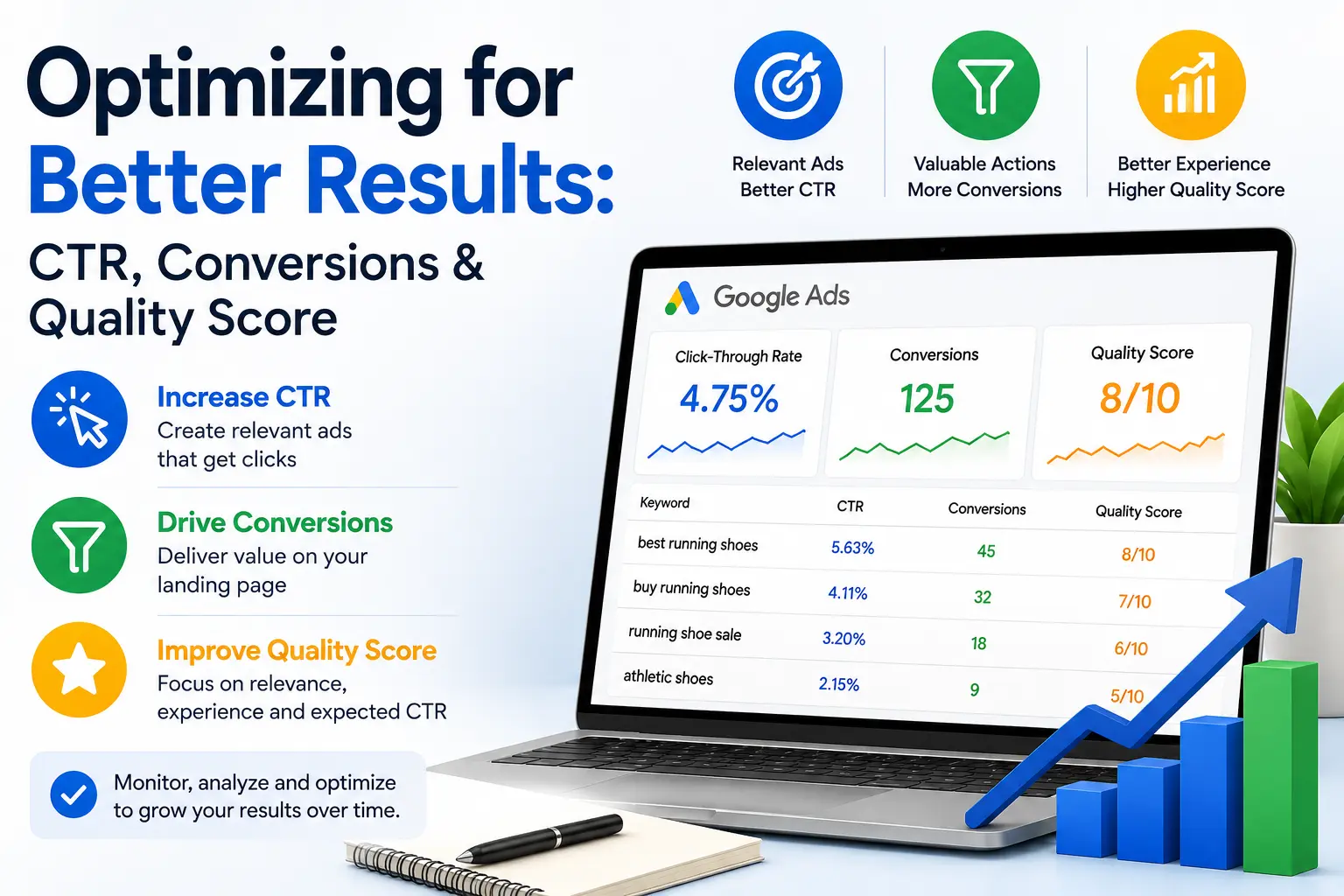
Conversion tracking in Google Ads measures whether clicks on ads result in valuable activities, such as purchases, signups, calls, or downloads. Click-through rate (CTR) measures the number of times an ad impression turns into a click.
Quality Score is another metric you will use to determine how an ad is performing based on three criteria: expected CTR, ad relevance, and landing page experience. Therefore, Quality Score can help you understand why performance is strong or weak.
Once you’ve created your campaigns, chosen your keywords, and written your ads, you may have the very first question as a beginner – “How do I know if this is working?” For many, the number of columns in Google Ads can be overwhelming. One option for a beginning ad manager is to ignore most metrics initially and focus on three metrics that clearly illustrate whether or not a user clicks on the ad, whether or not the user converts after clicking on the ad, and how healthy the ad campaign experience is for users.
The idea behind measurement is not to just appear to be productive/working. It’s to find out where/how to allocate additional budget, how to improve performance of Facebook ads, or how to stop wasting money on ineffective Facebook ads. Although Google Ads has everything you need to have access to these measurements, the best results for beginning ad managers come from always measuring a few key numbers as opposed to measuring everything at once.
Table of Contents
- The 3 easy metrics
- Measure Before Assessing Performance
- An Easy Method to Read the Data
- 30-Day Roadmap
- Practical Rules for New Visitors
- Final thought
The 3 easy metrics
There are three easy metrics to use when you track your advertising campaign’s performance.
1) CTR (click-through rate, sometimes expressed as a %)
CTR is defined by Google as the number of clicks divided by the number of impressions shown to users, giving an idea of how many ads shown are clicked on. In simpler terms, CTR helps answer the question, “Does this ad capture attention among users who see it?”
2) Conversion
Conversion or when a user takes an action after clicking on an ad and visiting your website, such as purchasing a product or signing up for a newsletter. A conversion is what really drives business results; click-throughs alone do not provide any indication of whether or not an ad has contributed towards achieving any type of desired outcome (i.e.; products sold). Since conversions occur after users’ interactions with an ad have taken place, this metric is most important in measuring success or effectiveness of the campaign.
3) Quality score (for search campaigns)
Quality score is a score from 1 to 10 assigned to each keyword based on expected CTR, ad relevance to the keyword used to trigger the advertisement, and user experience of the landing page where the user ends up after clicking the advertisement. Quality score can be used to diagnose issues where the keyword, advertisement, and landing page might be misaligned or disconnected. Although it is not necessary for beginner advertisers to check their overall quality scores daily when measuring success of a campaign, quality score can be applied as evidence that the three elements of an advertisement created are aligned or disconnected.
Metric 1: CTR Usage
CTR is often the simplest metric because it typically shows up (even for smaller campaigns) early and is very easy to see. If an ad is shown a lot, but it does NOT receive many clicks, this indicates that the ad may not be persuasive, relevant, or specific enough. This is logical as Google has defined CTR as simply how many clicks your ad received divided by the number of times it was seen.
For an absolute beginner, attempting to use CTR to compare the performance of two different versions of the same ad could be a very good first application of CTR. Suppose both ads are targeting the same group of keywords, and you notice that the version of the ad that consistently receives more clicks is more likely to be closer to matching the user’s intent when searching. While CTR by itself will not give you the whole story, it is a very clear indication of how good your ad copy is in the earliest stages of data collection.
Metric 2:Conversion Usage
Conversions help you to determine whether or not visitors completed any type of “valuable” (action you wanted) on the advertiser’s site after they clicked on your ad. Google indicates that there are many different types of conversions (creating separate conversion tracking) and examples include purchases, newsletter subscriptions, website, telephone calls, application downloads, store visits, and offline conversions (e.g., calling from a mobile device and going to the store). Understanding these differences is extremely useful, as there is not a single definition for success in every campaign..
For the new correspondent who just launched a blog, the definition of a successful conversion would be making contact via a contact form, capturing an email address, or downloading a guide. Google’s Conversion Tracking Resources state that you must define what you want to achieve as a conversion before creating a separate conversion action for each significant conversion. Creating separate Conversion Actions for the above will help make tracking successful conversions easy, since you will know exactly what you are measuring and how to measure it.
Metric 3: How to Use Quality Score:
Quality Score is not the ultimate goal, but it is a convenient way to gauge the health of your account. The Quality Score is used to help you understand if you are not performing well, and identify where the lack of performance may be coming from. The Quality Score then is the product of expected CTR, ad relevance, and landing page experience. Each of the three factors is rated above average, average or below average.
For example, if you have a low expected CTR, then you need to improve the compelling nature of your ad. Below-average ad relevance often indicates a mismatch between keywords and ad copy. Align your keywords more closely with your ad messaging. A poor landing page experience can reduce campaign performance. Ensure your landing page delivers on the ad’s promise. Beginners do not need a perfect Quality Score. Review your Quality Score weekly to identify issues early. Regular monitoring helps uncover opportunities for improvement.
Measure Before Assessing Performance
One common pitfall for new advertisers is launching ads prior to creating conversion tracking. Google’s suite of analytics tools state that conversion tracking is the way to measure how effective the ad is with respect to driving valuable customer actions. An ad can receive many clicks but without conversion tracking there will be no way to determine how many of the clicks generated valuable customer activity.
Google offers several methods for tracking different types of conversions such as online purchases, form submissions, button clicks, phone calls, application interactions, and offline activities. By utilizing these methods, success tracking will be able to be tailored to the goal, thereby eliminating guesswork.
An Easy Method to Read the Data
If you’re experiencing low CTRs, start by determining if your keyword(s) and ad headlines are in line with each other. If the customer is performing a particular search query, yet your ad doesn’t do a good job of replicating that word(s) in relation to your ad copy, your ad may be visible but not compelling enough to cause a person to click. Since CTR measures how many impressions were turned in to clicks, it is the first metric to review when customer interest appears to be low.
A high CTR with low conversions indicates problems after the click. Review your offer, landing page, and conversion process. Low conversions may suggest visitors do not see enough value. Use Quality Score to identify potential performance issues. Review expected CTR, ad relevance, and landing page experience. These factors can reveal why campaign performance is weak. Use these insights before changing ads, keywords, or landing pages. A structured review helps beginners make informed optimization decisions.
30-Day Roadmap
Days 1 – 3: Establishing a measurement baseline:
Set up at least one conversion action before evaluating campaign performance. Google uses conversion actions to track valuable customer activities. These activities can include sales, leads, phone calls, and downloads. Accurate tracking helps you measure campaign success effectively. Then you will need to determine what “success” will be defined as for this campaign (click, lead, capture, purchase, call). Next, you should follow the Google guidelines on how to create the appropriate conversion actions that will allow you to capture the information needed to track “success”.
In Google AdWords you will have the capability to run reports showing both clicks and impressions as well as calculate both the Click Through Rate (CTR) and any conversions. You will also have to run a report that will show you the Quality Score for your Search Campaigns.
Days 4-7: Validate Initial Relevance
Use CTR to evaluate how well your keywords and ads work together. Review CTR regularly to measure ad engagement. Remove keywords and search terms that attract irrelevant clicks. Eliminating poor matches can improve long-term CTR performance. Ensure your landing page matches the promise made in the ad. A consistent landing page experience supports a better Quality Score.
Days 8-14: Fix Your Weakest Area
If your Click-Through Rate is Poor, test a new headline or adjust your Keywords in a more relevant grouping. The Click-Through Rate indicates whether your Ad has gained Clicks based on the prior Impressions.
If your conversion rate is low, review your landing page carefully. Ensure all essential elements are present and functional. Use a clear and compelling call to action. Low conversions may indicate visitors are not taking meaningful actions. If your Quality Score is low, review its individual components. Check your expected click-through rate, ad relevance, and landing page experience. Identify weak areas and make targeted improvements.
Days 15-21: Compare Patterns
When you conduct ‘A/B’ Split Testing with different variations of your Ad(s), only keep the version with the Higher Click-Through Rate, as long as that same Ad continues to bring you Qualified visitors. The Click-Through Rate is a great tool for comparing performance/results of every Ad tested during the ‘Initial Phase’.
Identify keywords that generate conversions and deliver business value. Pause or remove keywords that spend money without producing results. Use conversion tracking to connect ad performance with business outcomes. Review your Quality Score again after making changes. Look for improvements in expected CTR, ad relevance, and landing page experience. Use these signals to diagnose and resolve performance issues.
Days 22–30: Determine how to scale, fix or pause
Increase budgets only for campaigns that generate valuable conversion actions. Do not base budget increases on clicks alone. Focus on keywords and campaigns that deliver meaningful business results. Pause underperforming keywords, ads, and landing pages after sufficient testing. Allocate more budget to proven performers and optimize weak areas. The Quality Score may assist you in identifying whether there are still discrepancies between the user’s experience.
Keep track of what increases CTR and improves conversions and negatively affects relevance so that you can base your next ad on data and not memory.
Practical Rules for New Visitors
Establish a single main conversion at first. Google allows multiple conversions, but one main will help to keep early analysis simple.
Use CTR as an indication of the attractiveness of the ad, not the true business value of the final result. CTR will be a flag for interest in the ad; conversions will be evidence that the ad resulted in a positive event.
Utilize the Quality Score as a diagnostic tool and not as a vanity metric to measure the success of an ad. Google specifically refers to it as diagnostic, and not as a direct score of success.
Performance should be checked periodically, instead of making drastic changes to performance.
When measuring success in marketing, it is generally best to compare long-term trends and patterns rather than review emotional “reactions” to individual day results.
Final thought
Google Ads offers many metrics, but beginners should focus on three key measurements. Track click-through rate (CTR), conversions, and Quality Score first. These metrics provide a simple foundation for measuring campaign success.
CTR indicates whether or not your ad attracted attention. Conversions indicate whether or not your traffic created value (returned money). Quality score indicates the level of performance of each of the keyword, ad, and landing page combination, either independently or as part of their work together to drive traffic to your website.
In my next blog, I will be sharing my hands on experience running the first google ad campaign.